
Echoes of Abandonment
Interactive Storytelling VR Experience and UX Research Project
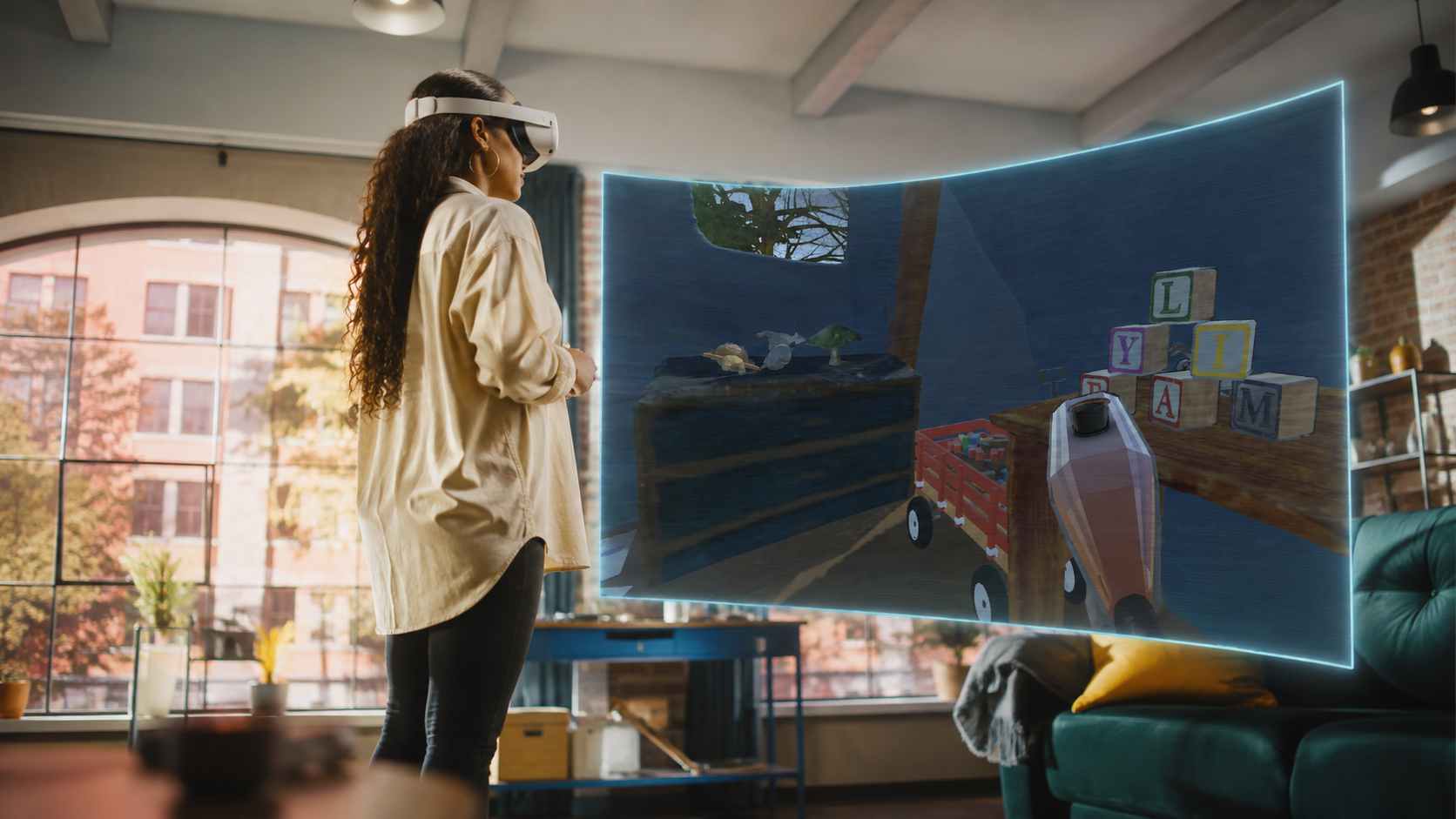
This is a Virtual Reality interactive storytelling experience about a child who is dealing with their parents divorcing. By putting on VR goggles we are placed in a world sculpted by hand in clay to resemble a kid's bedroom. Behind the door we hear parents arguing, and our goal, as a child, is to mute this argument by playing with our toys.
Each interactable toy has a sound attached to it, so that when we keep on playing we create a musical composition that allows us to again take control in our safe space over the world we experience.
Toys are "protectors" or "guardians" of imaginary reality that help kids develop creativity and a sense of safety. This project opens up a conversation about dealing with trauma that can be caused by being abandoned by one or both parents, or dealing with parents' conflicts while growing up.
The Problem
Echoes of Abandonment was presented at the KABK Graduation Show in 2024, where hundreds of visitors were experiencing it. I noticed that to some players it wasn't as intuitive with what toys they could interact with. Watching them play became a real usability study, and it surfaced a problem I hadn't designed for nor did I find academic literature that could solve this problem for me. I've decided to cover the research gap and move with this project from the design piece to a research proposal in the Master's of Game Technology program.
The interaction was designed quite straightforward: discover the toys, and through playing with them, quiet the argument behind the door. For a portion of players it wasn't intuitive which objects were interactive. They'd reach for scenery, miss the toys, or hesitate, unsure what the world was inviting them to do. In UX terms, the objects' affordances weren't reading clearly. A research question emerged: how should you mark an interactive object in VR without shattering the immersion the story depends on?
The Approach
To answer the question rigorously rather than by intuition, I designed a between-subjects experiment with 35 participants comparing three ways of marking interactive objects known to games UX research:
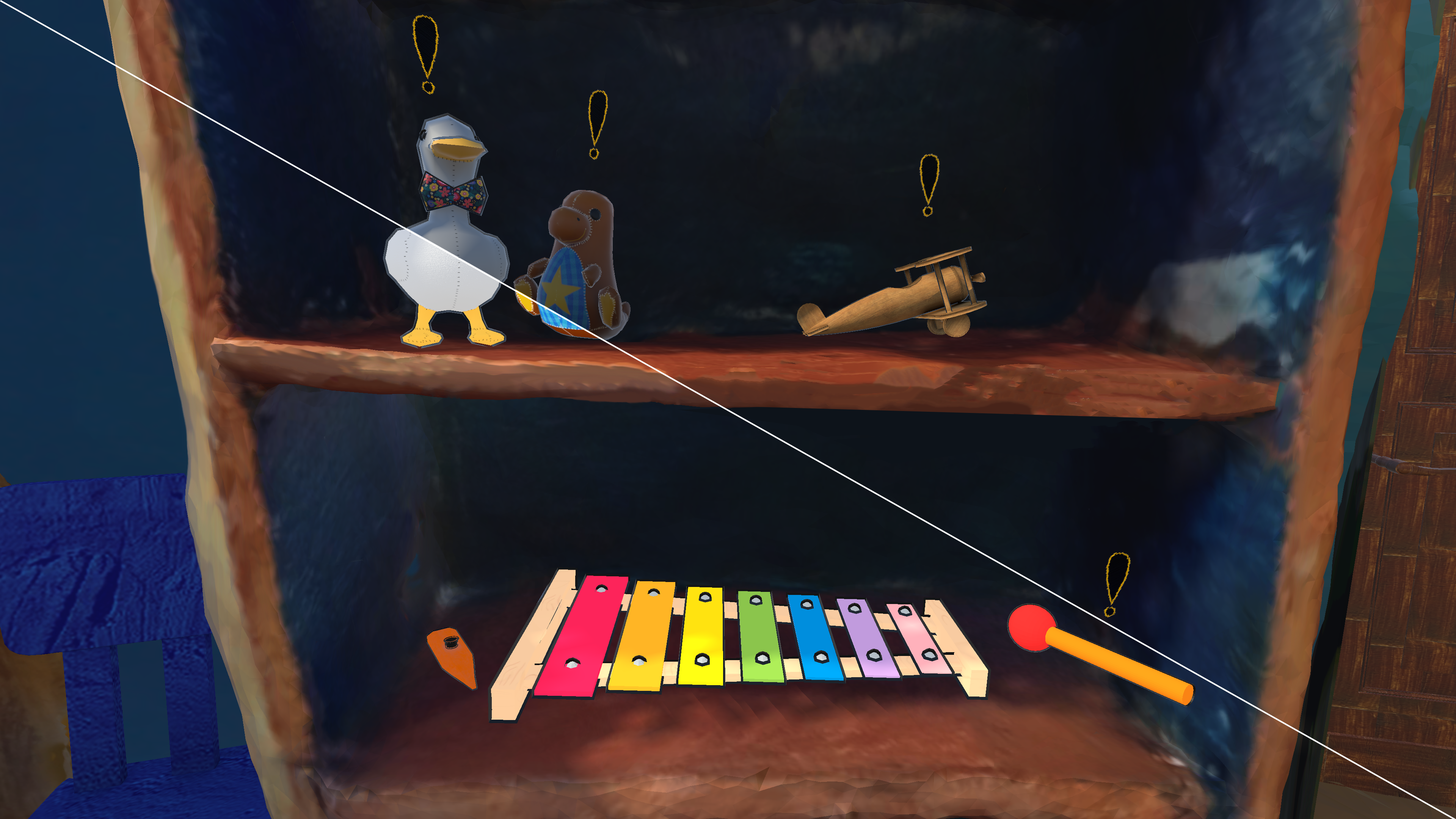
- Diegetic markers: cues that live inside the story world (a subtle brightness shader on interactive toys), so nothing about them breaks the fiction.
- Non-diegetic markers: cues layered on top of the world (a floating exclamation-mark icon), clearer as a signal but foreign to the fiction.
- A control group: no markers at all.
I measured narrative immersion using two academic tools — the Immersion Experience Questionnaire (short form) and the Narrative Engagement Scale, plus custom questions written for this study's specific question. Alongside the numbers, I ran observations of each playthrough and informal interviews, so I'd have the qualitative "why" behind the quantitative "what."
The Findings
The headline result failed to reject the null hypothesis. Statistical analysis in SPSS (ANOVA and Kruskal-Wallis) showed no significant difference in narrative immersion between the three conditions with effect sizes below η² = .02. Marker design, on its own, did not measurably move immersion in either direction.
For a moment that read like failure. However, it was the most useful thing the study could have told me, once I looked at the qualitative data for why:
1. Non-diegetic markers were actually the clearer signifiers. In the open responses, participants, especially less experienced gamers, found the exclamation-mark icon easier to read as "you can use this." The subtle diegetic shader divided people: some loved its invisibility, others simply didn't notice it. This directly addresses my original grad-show problem: the "immersion-breaking" marker was the one that solved the affordance issue, and it didn't measurably cost immersion to do so.
2. Sound design was the real immersion-breaker. Across every condition, participants pointed at the audio, not the markers, as the thing pulling them out of the experience. They complained about the layered sound of the musical toys and parent argument being too distracting to realise what the argument was about — despite the goal of the game being not to listen to the argument and mute it completely through playing music. The variable I was studying turned out to be less influential than a variable I wasn't. That's the study's most important design lesson: auditory UI deserves the same scrutiny as visual UI in VR, and I'd designed the sound with far less rigor than the markers.
Make sure to read a summary of my study in my research section, where you can also find my full paper and publication.
